by Terry Heick
As a society, we have a thought situation– specifically, an unsafe and long-lasting refusal and/or inability to think well and believe critically.
This is simply an opinion, however I hope not an extreme one. To make clear why this situation exists– or perhaps why I think it exists– would certainly call for a sweeping evaluation of cultural, social, political, and various other anthropological terms beyond the extent of TeachThought.
For beginners, glance practically any social media ‘conversation’ about any culturally important concern. If you differ that such a dilemma exists, the rest of this article will likely not deserve your time. If we can presume that statement to be at least partially true, though, we can see that as a market, after that we have a dilemma in education that is both a cause and effect of the above.
Education and learning both causes and is a result of thought. Education and learning and believed, at the very least conceptually, are as linked as the design of a structure and the structure itself.
In part, this ‘thought situation’ is additionally a crisis in language and is related to a parallel situation in affection. Connected are deficiencies in utility, understanding, patience, location, and cultural memory. However, for our functions, allow’s review a main crisis amongst the dilemmas: A deficiency in crucial thinking.
This is, partly, an issue of thought subjects and thought high quality: what we consider and exactly how.
On the surface, education– as it is– is not about training believed but instead concerning content. This shouldn’t be controversial, actually.
Education As It Is
Education is about organized into material locations and stratified by age. On a wide sight, the general structure can be taken a huge grid: The columns are the material areas, and the rows are the ‘age.’ We might additionally consider it the reverse, and it would not transform a lot.
Put briefly, the formal education system in the USA is developed for individuals to study (normally) four main groups of expertise (mathematics, science, social researches, and language arts) for thirteen years.
These content areas often tend to end up being much more complex however are only intermittently specialized (‘science’ becoming ‘chemistry,’ as an example, despite the fact that chemistry is still a science; for the record, I’m unsure why we do not reveal at least a little vision and wed scientific research and the humanities right into ‘new material locations’ that aren’t material areas in any way yet realize that this is insane talk with most and will save my breath).
The point is, education and learning– as it is– is about material, and mastery of content has to do with factors and qualities that either does or does not lead to certificates (e.g., diplomas) that enable increasingly specialized study (organization, regulation, medicine, etc) in post-secondary education and learning (like college/university) for the purpose of ‘career preparation’ (which, I’ve used, should not be the purpose of college
Three of one of the most visible components of many modern K- 12 public education and learning systems: instructors, web content, and letter qualities, with both former components commonly combined (e.g., ‘mathematics teacher’ or ‘art teacher.’) Also hugely visible education components: trainees, examinations, computer systems, publications, wall surfaces, desks, hallways, groups, bells, schedules, front-of-the-room blackboards and whiteboards, and so on.
The above is not a comprehensive evaluation, and there are many exceptions of discovering methods and types, yet they’re still exemptions. Certainly, this overview is not, as far as I can inform, deceiving in its characterization of contemporary public understanding forms and areas.
And if the above is much more or a less exact thumbnail of just how humans learn in formal education, it should become at the very least somewhat clear that we have a problem.
A sort of deficiency
The McDonaldization of The Class
You can not examine the top quality of a ‘thing’ without understanding what the important things should certainly do. This is easy for kitchen utensils and testing for art and affection and individuals: To clarify an education and what it ‘need to be’ is to impart what ideally is a very personal and ‘neighborhood’ ideology on every person else. This is due to the nature of standardization.
In 1993, George Ritzer wrote a publication– which owes itself in large part to previous work by lots of, consisting of Max Weber– called The McDonaldization of Society The book is an expedition of the causes, impacts, and nature standardization via the lens of the McDonald’s American dining establishment chain.
McDonald’s is rarely the initial company to utilize such standardization. Actually, Industrialism itself– the spine of 20 th-century America– owes itself to the principle in many ways ushered right into ‘appeal’ by Henry Ford. Whether or not you find a ‘issue’ with industrialism is initially a philosophical concern.
George Ritzer has actually taken main elements of the work of Max Weber, expanded and upgraded them, and produced a vital evaluation of the influence of social architectural adjustment on human communication and identification. The central motif in Weber’s analysis of modern-day society was the procedure of Rationalization; a far-ranging process whereby standard settings of thinking were being changed by an ends/means analysis interested in efficiency and formalized social control.
For Weber, the classical manifestation of this process was the Administration; a big, official company characterized by an ordered authority structure, reputable department of labor, composed policies and regulations, impersonality and an issue for technological capability. Governmental companies not just stand for the process of justification, the framework they trouble human interaction and assuming furthers the procedure, resulting in a significantly rationalized globe.
The process impacts all aspects of our everyday life. Ritzer recommends that in the later component of the Twentieth Century the socially organized type of the snack bar has ended up being the organizational force standing for and expanding the process of justification further into the realm of everyday communication and private identification. McDonald’s works as the case version of this process in the 1990’s.
In guide, Ritzer describes that one impact of limitless rationality is impracticality: “A lot of especially, irrationality suggests that logical systems are unreasonable systems. By that, I imply that they deny the basic mankind, the human reason, of the people who function within or are served by them.”
Which brings us back to education and learning and our shortage in essential reasoning.
Systematizing anything is a trade. I’ve discussed this loads of times before– below for example And below And lots of other posts and tweets and posts because, it seems to me, it represents one of the inherent problems in our design of contemporary knowing. In other words, in education and learning as it is , every single student no matter history, ethnic background, sex, passion, family members background, neighborhood needs, or familial expertise will study the same point provided in similar ways– significantly like a kind of scholastic lunchroom.
The implied hope in an educational program delivered to such trainees (i.e., all of them) in such a style (i.e., the ‘grid strategy’ discussed over) is that it will certainly fit everybody’s demands. It is made to be sensible.
And the approaches of distribution of such an educational program (e.g., educators, class, publications, applications, examinations, and so on) are likewise created to be logical. That is, both the curriculum (what is researched) and the discovering and educational layout models (exactly how it is being studied) are designed to be functional: testable, visible, and deliverable to each and every single student regardless of– well, anything. Deliberately, public education and learning is (meant to be) for all trainees all over, no matter what.
But what regarding assuming? Can important reasoning– wrought and wielded by the thinkers– coexist in a standard understanding atmosphere developed to promote the widest varieties of students to proficiency of one of the most typical scholastic material? Potentially– however that might not be the best method to ask the question.
Is education created to advertise love, inquisitiveness, inquiry, and important thinking?
People race tractors and adventure on hot air balloons, yet that does not indicate either is entirely fit to the job. Beyond education and learning, it is in the variation of function and application that our entertainment stays. However within education and learning? Generation after generation of trainees experiences the shortage.
What Regarding Essential Believing?
In’ What Does Important Thinking Mean’ I stated:
“Vital reasoning is among the initial reasons for modification (personal and social) yet is a pariah in schools– for nothing else reason than it conditions the mind to believe the kind and feature of whatever it sees, including your classroom and everything being shown in it. In vital thinking, the reasoning is only a technique to arrive at informed objection, which is itself is a starting point for recognizing one’s self and/or the world around you. While in function it can run parallel to the scientific method, scientific research intends to arrive at an impartial, neutral, and zero-human verdict. In vital thinking, there is no conclusion; it is continuous interaction with altering situations and new knowledge that allows for a wider vision which allows for new proof that starts the procedure over once again.”
And that’s getting us closer to our shortage of important believing culturally, which partly owes itself to a parallel deficiency of essential reasoning in education.
Whether we can ‘instruct’ critical thinking is usually said, but that appears to be misreading. Rather than ask if schools can instruct essential reasoning– or even if vital thinking can be taught– we may begin by asking what we shed if we live in a world where it doesn’t happen.
While totally brand-new types and approaches and reasons to learn will likely eventually interrupt education and learning as it is from the outdoors, if we’re really feeling classic with the old sturdy body of education, we can a minimum of address that deficit of vital reasoning by embedding right into the design of education. This can be completed in any kind of variety of methods, however some fruit appears to be low-hanging.
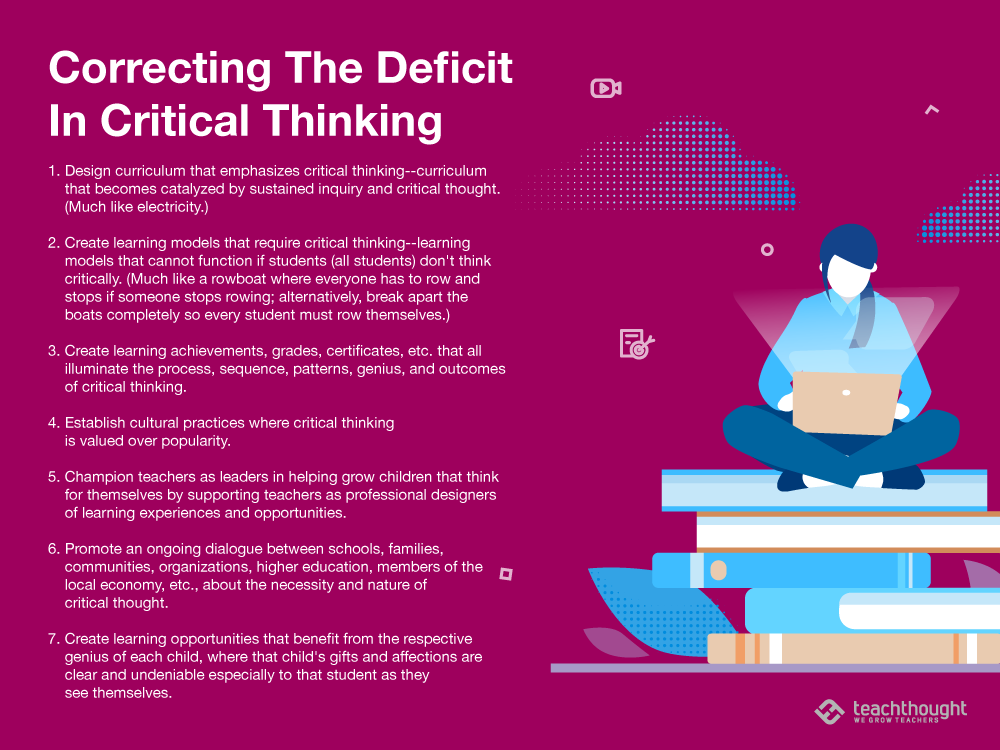
1 Design educational program that stresses important thinking– curriculum that comes to be catalyzed by sustained questions and important idea. (Just like electrical energy.)
2 Produce learning versions that need essential thinking– discovering models that can not function if pupils (all trainees) do not believe critically. (Similar to a rowboat where everyone needs to paddle and stops if someone stops rowing; alternatively, break apart the boats totally so every trainee have to paddle themselves.)
3 Develop discovering achievements, qualities, certificates, etc that all illuminate the procedure, series, patterns, brilliant, and outcomes of essential reasoning.
4 Establish cultural techniques where crucial reasoning is valued over appeal. (Democracy could benefit.)
5 Champ instructors as leaders in aiding expand children that believe on their own by sustaining teachers as professional developers of discovering experiences and chances.
6 Advertise a continuous discussion in between colleges, households, neighborhoods, organizations, college, members of the local economic climate, etc, concerning the necessity and nature of vital idea.
7 Create finding out chances that take advantage of the respective genius of each youngster, where that child’s presents and affections are clear and undeniable specifically to that student as they see themselves.
We can go on and on and I worry I’m moving also away from the factor: Schools as they are are not ‘created for’ vital thinking and now and as a society (and earth) we are struggling with the following deficit.
This implies we could focus less on the iterative enhancement of education and even more on education as it might be